Inception and Limits
Recreation, Recovery, Transformation
I love vanilla ice cream. Black Walnut, Butter Pecan; I love ice cream. Ice cream is what people did on Sundays. Everybody would go home after church, you would eat, and then later on the parents would take the children over there [the Royal Ice Cream Parlor] to eat ice cream.
Virginia Lee Williams – Royal Ice Cream Parlor Sit-ins
Author Reflection: V. Gallagher
These are the opening lines of a documentary film about the 1957 Royal Ice Cream Parlor Sit-in that occurred in Durham, NC. They resonate with me, Victoria Gallagher, because I, too, love ice cream (although I am partial to chocolate) and when I was young, my dad enjoyed taking our family to get ice cream at a neighborhood ice cream parlor. These types of connections between individuals – e.g., a shared love of ice cream – are referred to as “identificatory” by Kenneth Burke and theorized as the rhetorically powerful ways we express and experience our shared humanity through the particularities of our lives. These words have additional rhetorical significance because they were spoken by Virginia Williams, one of the “Royal Seven”:
On June 23, 1957, nearly three years before the famous sit-in at the Woolworth’s store in Greensboro, North Carolina, Reverend Douglas Moore, the pastor of Asbury Temple United Methodist Church in Durham, organized a protest at the Royal Ice Cream Company. Accompanied by six fellow church members, all of African American descent, Moore and his group, who came to be known as the “Royal Seven,” entered the ice cream parlor located in a building on the corner of Roxboro and Dowd streets in Durham. They sat down together and ordered ice cream in the section of the establishment posted as “whites only.” The owner called the Durham police, who arrested the seven protesters for trespassing. Ultimately, an all-white jury found them guilty and the presiding judge levied fines totaling $433.25. Though challenged all the way to the United States Supreme Court—which refused to hear the case—the charges were upheld and reaffirmed in subsequent North Carolina State Supreme Courts’ rulings (“Negroes Lose” 1958).1
Sit-ins such as this one made visible the challenges and struggles faced by Black and African American citizens in their everyday activities, activities such as going out for ice cream on a Sunday afternoon. Leland Griffin, a founding scholar of rhetorical social movement studies, argued that “the inception of a social movement occurs when ‘the roots of a pre-existing sentiment, nourished by interested rhetoricians, begin to flower into public notice, or when some striking event occurs which immediately creates a host of aggressor rhetoricians and is itself sufficient to initiate a movement.’”2 The Royal Ice Cream Parlor Sit-In and the more well known Greensboro Sit-In clearly illustrate each aspect of the inception process articulated by Griffin. The 1957 sit-in emerged from the pre-existing sentiments of frustration with unjust Jim Crow laws that intruded on everyday life, it was nurtured by interested rhetoricians such as the Reverend Douglas Moore, and it began to flower into public notice in Durham through the Royal Ice Cream Parlor Sit-In. In turn, the Greensboro Sit-In illustrates the kind of striking event that Griffin describes as creating a host of “aggressor” rhetoricians sufficient to initiate a movement: after its inception in February 1960, sit-ins quickly spread across North Carolina, South Carolina, Virginia, Florida and Tennessee. Indeed, by the middle of March 1960, 48 Southern cities were experiencing protests and sit-ins “over an assortment of issues concerning segregation.”3
Most importantly, for our purposes, the 1957 Royal Ice Cream Parlor Sit-in and the 1960 Greensboro Sit-in at the Woolworth lunch counter, provide the historical context for King’s speech at the White Rock Baptist Church in Durham, NC, a speech that marked a critical turning point for Dr. King and for the Civil Rights movement and that, in 2014, became the basis of the Virtual Martin Luther King Project. Such moments of opportunity are the inception points for kairotic action and in this case, at least according to Virginia Williams, it all began with ice cream.
Overview
Section one, Inception and Limits, introduces the theoretical underpinnings and the digital humanities vision of the project. Here, we present the vMLK historical experience as a case study for examining and assessing publicly engaged recovery scholarship. As recovery is at the heart of Black Digital Humanities scholarship, we conceptualize the inception of this project as an opportune moment of recovery. And we consider how digital humanities scholarship can be productively enhanced by exploring the limitations and consequences of such work. Additionally, we illustrate how the vMLK Project responded to and expanded the digital humanities terrain.
This section features the project assets that make up the historical experience and critical insights about the historical context. Particularly, we provide answers to key historical questions (e.g., why King’s 1960 speech was given in Durham rather than in Greensboro, since it was given in response to the start of the Greensboro Sit-in, and what the consequences of this speech were in relation to the trajectory of the civil rights movement). In this section we incorporate the Counter Histories documentary of the 1957 Royal Seven Sit-in at the Royal Ice Cream Parlor in Durham, NC and briefly examine the historical debate about whether civil rights could best be achieved through the more traditional rhetorical means of preaching, letter writing, petitioning or through the more embodied means of direct nonviolent social action such as boycotts and sit-ins. This historical contextualization involves the presentation of archival materials, including photographs that were taken at the White Rock Baptist Church on the night in 1960 when King gave his speech as well as the additional oral history of that night provided by Ms. Virginia Williams, Ms. Mary Williams and others.
Ultimately, we argue that any kind of recovery or recreation work has limits. But understanding the limitations (of both the historical and intellectual contexts as well as of the project goals and technology) and foregrounding those limits, yields a productive site for creation and critique. The vMLK Project, as our example, is not an exact replica of an historical event. We can’t make that. And we do not wish to do so. Nor is it a kind of immersive project where we “drop” audiences into an experience and then invite them to draw conclusions first hand about their experience without consideration of context. Rather, through the vMLK Project we demonstrate that there is something powerful about creating an embodied sense of what it was like to be there, in the room, experiencing an historic moment of public address while also being grounded in the realities of the present. The vMLK Project encourages audiences to look through King and his words to better understand and appreciate the community, the context, and the extent to which digital technologies provide affordances for crafting kairotic conditions, i.e. opportune moments for personal and civic transformation.
Opportune Moments in and with communities
A key characteristic of opportune moments is that they are ephemeral, that they are here, they matter, and they are gone. Rhetoric as a field of study and practice has long been fascinated by these fleeting moments of change and in classical rhetoric these moments were understood to be experienced primarily through public speeches or orations. Indeed, Dr. King referred to time as neutral, as something that could be used for productive or unproductive ends and he sought to use oratory to create or harness moments of opportunity productively. Such opportune moments, where an audience/public is moved with/by/through communication, are central to the way rhetoric is practiced, analyzed, and taught still today. The complication, of course, is that by studying these fleeting moments, we are always contending with echoes or traces of communicative acts. Echoes are repetitions of sound – the afterlife and consequence of a communicative act. So from the start of the project, we have been interested in sound, in both the creation of these echoes and how they live – where they reverberate, who hears them, and how they change as they echo back. Studying echoes, studying opportune moments and thereby studying the central imaginaries of rhetoric is equal parts daunting, challenging and exciting. Through the vMLK Project we reimagine the practice and study of rhetoric in a digital age when the recovery of distant, lost (or stolen) echoes becomes a real possibility.4
Our goal throughout this work is to take up the question(s) of opportune moments and their ephemerality, and to explore how and to what extent we can sustain, extend, or re-experience these moments of change in and with communities. In addition to the aspects of time, agency and positionality, understanding kairos as an opportune moment that could be recovered and reanimated through the vMLK Project means taking digital technologies seriously, while also attending to community, collaboration, and place.
In terms of community and collaboration, we began with a conversation with the pastors and deacons at the White Rock Baptist Church, guided by these questions (the same questions we still consider together whenever we meet about the project): how can this collaboration be useful and of value for White Rock? What do you want this project to look like/to be? The pastors, deacons and congregants’ various answers to these questions appear throughout the six sections of our digital publication. The response featured in this section was an expressed desire for people today to feel what the members of the congregation and community felt on that night in 1960 when everyone was excited to have Dr. King coming to speak at a church in Durham. They wished, in other words, for a recovery of the past that could inform the present.
This expressed desire is particularly apt in relation to Susan Wells’ conceptualization of “kairotic refunctioning of the past.”5 In her discussion of Walter Benjamin’s understanding of time, Wells argues the following:
“While Benjamin is deeply interested in the present moment, he emphasizes that specific elements of the past become resources only at unique historical junctures; if they are not taken up, they are lost forever. For him the present opens to a discontinuous future. Benjamin’s understanding of time is deeply relevant to contemporary rhetorical discussions of history and memory, offering theoretical tools to explain why social movements have invested in the kairotic refunctioning of the past.”6
Guided by this understanding of time and public memory in relation to social movements, we sought to recreate and preserve specific elements of the past, providing for the “potential for encounter between the living and the dead.”7 Through the vMLK Project we reach back to ignite ways of thinking grounded in a renewed regard for the past and anticipation of a future, and to thereby contribute to contemporary rhetorical and digital humanities scholarship.
Digital Humanities and Technologies of Recovery
The rise of digital humanities as an academic discipline escalated during the early 2000s and into the 2010s. Indeed, while many academic institutions and, particularly, humanities-related units, were undergoing severe budgetary and other challenges, digital humanities saw increased investment in the form of grant funding opportunities and new program development. This promise, both in terms of financial as well as scholarly interest, was invigorated by the range of humanities scholars engaging in work made possible through digital technologies.
The critical Debates in Digital Humanities series published by the University of Minnesota Press was a key example of this trend. The series worked to illustrate the critical debates that animated the early days of the field of digital humanities from a varied set of disciplines.8
A common approach to books published on digital humanities during this time was that of practitioners’ guides. For instance, Digital Humanities in Practice,9 offered a range of case studies that specifically illustrated topics of concern for academics looking to develop digital humanities projects. Using Digital Humanities in the Classroom: A Practical Introduction for Teachers, Lecturers, and Students10 similarly was a practitioner guide on digital humanities, specifically focused on utilizing digital humanities in pedagogical practice similar to The Digital Humanities: A Primer for Students and Scholars.11 In SpecLab: Digital Aesthetics and Projects in Speculative Computing,12 Johanna Drucker took a different approach to writing about digital humanities. Her book outlined the digital humanities laboratory she co-founded, the process of founding, and offered brief descriptions of some projects developed at SpecLab in order to demonstrate the importance of critical aesthetic principles through speculative computing. In addition to offering a set of practical considerations for students and scholars interested in speculative computing, what was particularly engaging about the book was the range of projects and theoretical development it presented.
It was into this intellectual context/conversation that the Virtual Martin Luther King (vMLK) project was first articulated in 2014-15. While many digital humanities projects were geared primarily toward academic audiences and featured approaches such as digitization of humanities-based archives/materials, historiography, speculative computing, or literary epistemology, we grounded the vMLK Project in rhetorical epistemology, digital world building, and a collaborative partnership with local communities in order to craft a transmedia digital project for the public.13 Kim Gallon’s 2016 work on Black Digital Humanities and technologies of recovery was particularly productive for us during this inception period because Gallon articulated an intersection of black studies and digital humanities by way of projects that sought to restore the humanity of black people through the “recovery of lost historical and literary texts.”14
Three themes emerged from Gallon’s conceptualization of technologies of recovery that are critical to interpreting, illuminating and assessing the vMLK Project. First, for Gallon, technologies of recovery are characterized by documenting the history and everyday experiences of African American/Black life, especially historical and literary texts that would otherwise be “lost.” Such work, for Gallon, demonstrates a commitment to the preservation and accessibility of “Black knowledge, history, experience, and education of Black People and all people.”15
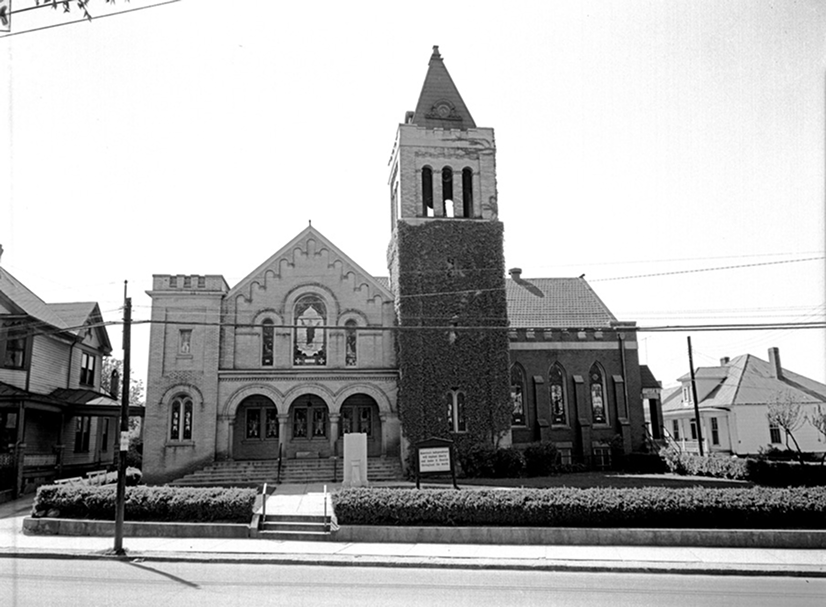
King’s 1960 Creative Protest [Fill Up the Jails] speech was one such “lost” text because, as indicated in the introduction section, despite the historical and rhetorical significance of this speech, no audio recordings have been found and the original location of the speech, White Rock Baptist Church, was torn down in 1967 to make way for the Durham Freeway. David Hill, Head of the School of Architecture at NC State and a collaborator on the vMLK production team, speaks directly to these issues, reflecting on his own experience growing up in North Carolina, knowing about the Greensboro Sit-ins but having never heard about King’s speech at White Rock.. As Hill expresses it, working on the vMLK Project provided him with a previously missing part of a historical story, a story where he knew some parts but through the project came to know much more.
David Hill discussing historical connections through the project
Similarly, the reason King gave the speech in Durham, NC rather than in Greensboro, NC, is recovered and highlighted through the vMLK Project. Interestingly, in his 2023 award winning biography of King, Jonathan Eig does not address or explore this particular historical detail, instead connecting his description of King’s speech in Durham in 1960 with King’s decision to move from Montgomery to Atlanta on the one hand, and to the partnership that King began to pursue with the student movements that were springing up on the other.16 Here is Eig’s brief account of the context for this pivotal speech:
“While many southern white reporters viewed the student protesters cynically, and white business leaders and politicians dismissed the young upstarts, King embraced them. As in Montgomery, he didn’t start the uprising, and yet, again, he found himself thrust into a position of leadership, improvising all the way. On February 16, [1960] he traveled to Durham and spoke to a packed crowd of more than 1,200, including students from more than a dozen colleges in North Carolina, South Carolina, and Virginia, telling them they had the moral advantage over their opponents. ‘Let us not fear going to jail,’ he said. ‘We must say we are willing [and prepared] to fill up the jails of the South.’”17
Marvin Blanks delivering Fill up the Jails Speech – Let us not fear
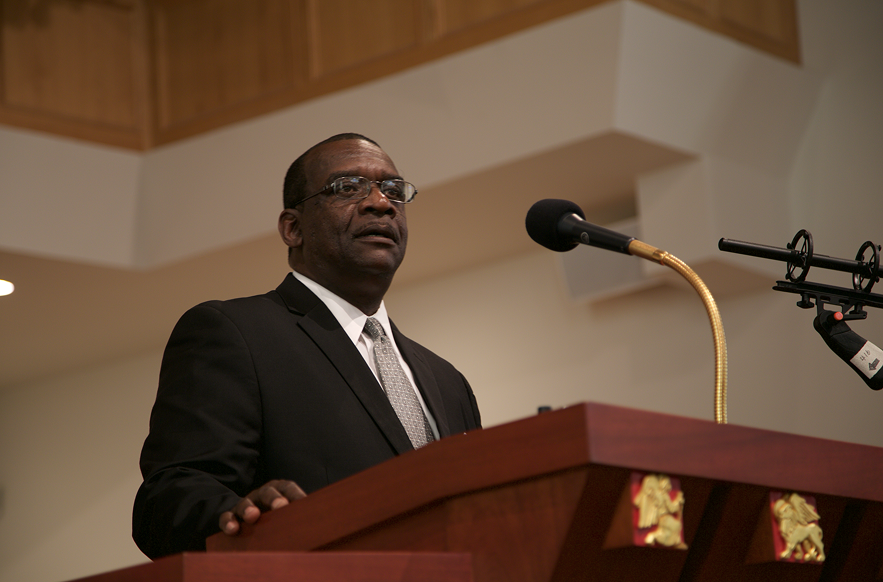
King himself referred to this speech, and particularly the “fill up the jails” line, multiple times in the months and years that followed, stating in an interview in 1963 that the sit-ins and other protests featuring nonviolent direct action were finally helping the movement to achieve the “fill up the jails” goal and to put pressure on communities across the south to end practices of segregation in public spaces and businesses.
And there is more to the story. As the Counter Histories documentary reveals, King and Moore were classmates at Boston University. While in Boston, they had pursued decidedly different paths when it came to the question of advancing and advocating for the rights of Black citizens. Moore and another student named George Thomas tried to encourage their classmates, including King, to join them in attempts at direct action but were largely unsuccessful in convincing others.18 At the time, significant numbers of African Americans opposed agitation and direct action and King himself focused on oratorical forms of agitation such as speeches, letters and sermons. Indeed, Taylor Branch described King’s efforts to fight segregation in the 1950s as a conversion approach “which resulted in great fanfare but little substantive change.”19
In contrast, when Rev. Douglas Moore left Boston University for Durham, NC, he continued to pursue direct action as a means to challenge segregation and racial discrimination. In a book chapter about Moore and the Royal Ice Cream Parlor Sit-in, Gallagher, et. al. describe how Moore petitioned the Durham City Council to end segregation at a public library and a city-owned theater. And, “after those petitions failed, he moved toward nonviolent direct action, attempting to enter a whites-only swimming pool in Durham.”20 Yet, as indicated in the Counter Histories documentary, the Royal Seven were left to fight the court battle – as well as the battle of public opinion – by themselves and did not receive official recognition until 2008, when an historical marker was approved and sited in Durham, NC.
Counter Histories Documentary on Royale Ice Cream Parlor
Still, it was this combination of connections and disconnections that led to King giving his A Creative Protest [Fill Up the Jails] speech in Durham on February 16, 1960. Floyd McKissick, the lawyer for the Royal Seven, and Rev. Moore, along with many others, were surprised when on February 1, 1960, students in Greensboro, NC began their sit-in at the Woolworth’s. The two men drove to Greensboro to support the students (who had done little planning and possessed no clear goals) by holding training sessions and developing a strategy to help the sit-ins spread.21 And Moore reached out to King, inviting him to come to Durham to speak because, as Moore expressed it, “In Durham we’re ready” to hear King’s endorsement of direct action and nonviolent confrontation as the future of the movement.
Marvin Blanks delivering Fill up the Jails Speech – You Students of North Carolina
Through the Royal Ice Cream Parlor sit-in documentary, and the recovery of the voices and stories of Virginia Williams and Rev. Douglas Moore among others, the vMLK Project thus provides deep engagement with a previously underexplored historical moment. Audiences learn about the fuller story and they are led to consider and appreciate the different approaches to achieving civil rights that were being articulated across various communities and organizations at that time. Through the vMLK assets and experiences, a more thorough-going experience of the pivotal nature of King’s speech is brought to the fore, wherein for the first time he endorsed the student-led sit-ins as the future of the civil rights movement and promised the full support of his organization, the SCLC, for nonviolent direct action. As Gallon herself noted at the African American Digital and Experimental Humanities Initiative (AAD-HUM) conference in 2018, the vMLK project successfully enables audiences and visitors to explore civil rights history in ways that highlight the role of little known persons (e.g., Rev. Douglas Moore, Ms. Virginia Williams, and Duke divinity students) and of other protest efforts, including the 1957 Royal Ice Cream Parlor Sit-In; see also, Gallagher and Renner, 2023.
The second theme Gallon articulates as essential for projects characterized as technologies of recovery is that they provide a critique and understanding of race and digital technology. Specifically, Gallon exhorts scholars working at the intersection of black studies and digital humanities to “unmask the racialized systems of power at work in how we understand the digital humanities as a field and utilize its associated technologies.”23 There are several ways in which the vMLK Project unmasks systems of power in humanities disciplines and in associated digital humanities projects and technologies. These include challenging traditional notions about how humanities scholarship is produced (e.g. by a lone scholar who demonstrates prodigious expertise/ intellectual insight through a book or monograph vs. a team of multi-disciplinary students, community members and scholars who generate projects for the public), that citational practices are tied to texts and documents rather than communities and creators, and that historical knowledge is the central focus of digital humanities scholarship rather than rhetorical epistemologies.
As noted in our introduction, in an article published in the Washington Post May 10, 2018, titled, “Is technology bringing history to life or distorting it?,” the vMLK Project along with several other digital humanities-related efforts were held up for scrutiny in relation to “the way history is becoming less about dates and more about data.”24 Author Steve Hendrix uses a variety of projects to acquaint his readers with digital humanities including a U.S. Military Academy phone-based app (ala Pokemon Go) that enables visitors to see how George Washington’s troops strung a massive iron chain across the Hudson River; a voice cloned rendition of JFK’s Dallas speech text, a speech that he never delivered due to his assassination; colorized photos of Lincoln and of a young girl at Auschwitz, a hyper-detailed digital model of Chicago’s 1893 World Columbian Exhibition, and a visual and digital model of London’s St. Paul’s Cathedral and church yard. He describes these projects as making history more visceral by tapping into the feelings behind the facts. And he quotes the director of digital initiatives at the American Historical Association who notes that: “It feels a little like we’ve been given the ability to time travel.” In regard to the vMLK Project, Hendrix asserts that it combines performance, scholarship and technology and that hearing a speech rather than reading it can make the exhortations more comprehensible. He also cautions about creating images and sounds that depend on guesswork, subjective choices and even acting, and that rub up against cherished academic norms, such as the citational practices of historical scholarship.25
Throughout this digital publication, we demonstrate a very different approach to humanities scholarship and to digital technologies. We attend to how decisions are made, who makes them, whose bodies and voices are seen and heard and in what ways, and the community building and collaboration that are at the heart of the project. We present a robust sense of the community that brought the vMLK Project into being and continues to nurture and celebrate it through inclusive citational practices. We theorize the project in terms of rhetorical concepts and assess its consequences across multiple contexts in addition to contributing to historical knowledge.
Interestingly, rhetorical and communication scholarly communities have taken a different tack in categorizing and critiquing the vMLK project. Trevor Perry-Gile, in an interview for National Communication Association’s Communication Matters Podcast declared this work a new area of study in rhetoric, what he suggested might be called forensic rhetoric.26
And, like many others, he asked about whether we were planning to move on to recreate other speeches and/or rhetorically important historical moments. But the idea of producing a systematized approach to recreating digital experiences of other historic public addresses is not what the vMLK Project is about. As we demonstrate throughout this publication, the project instead illuminates how technologies may be utilized to craft the conditions for kairotic action and civic engagement and to illuminate the basis for ethical advocacy, for ethical uses of technology and for ethical community engagement.
The third theme that characterizes technologies of recovery is the innovative use of digital tools to consider how studying Black History reveals the constraints and possibilities of digital technologies and, in so doing, also illuminates the ways Black Studies may come to bear on and transform the digital processes and tools used to study humanity.27 In regard to the vMLK Project, this is a particularly important theme and set of contributions.
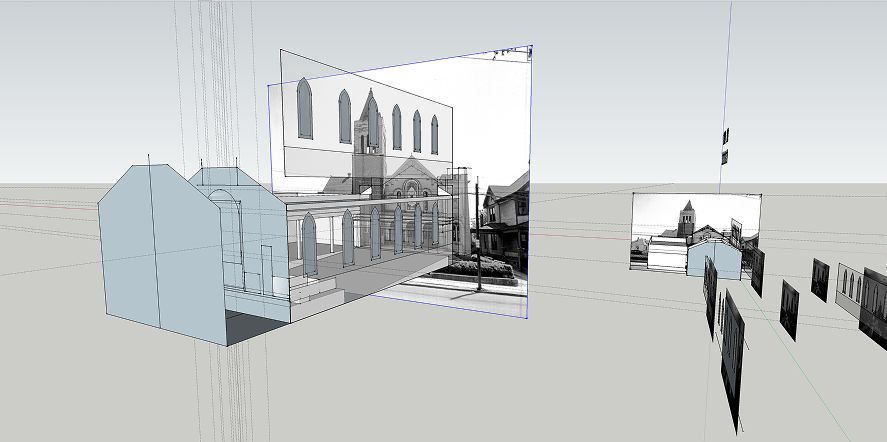
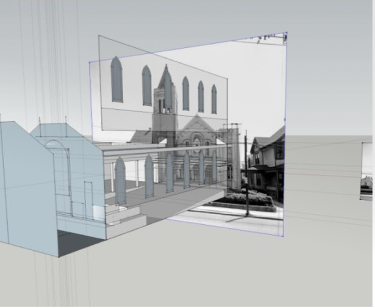
David Hill highlights some of the relevant constraints of this work in his discussion of the challenges he and his students faced in creating the digital model of the church sanctuary, given that the plans for the building were largely missing/unrecoverable. As Hill notes, congregation members provided archival photos to help him and his students understand the dimensions. The church secretary provided plans for the installation of an organ that was particularly helpful in determining other aspects of the space. These materials along with Sanborn maps, large scale maps of North Carolina towns and cities created from 1860 – 1970, were the only evidence that remained. And, as we demonstrate further in Sections 2 and 5, the use of digital tools to recover archival photographs and local maps enables audiences to confront and directly examine the politics and the consequences of urban renewal, illuminating the disproportionate impact on Black neighborhoods and institutions, including churches. Finally, in Section 5 we examine the limitations and racialized aspects of developing the animation assets and the King avatar for the VR experience of the project, providing a case study of how digital humanities scholars and students can address such issues in ways that lead to innovative, ground breaking work.
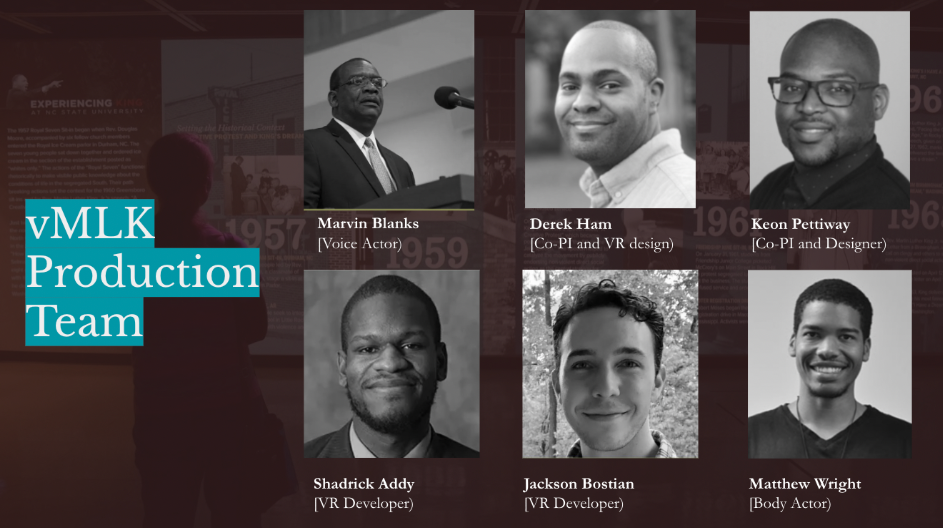
One additional key tenet of Gallon’s approach is that a Technology of Recovery features the work of Black scholars and innovators. And indeed, the project production team included talented Black scholars and innovators who brought an array of expertise, perspectives and experience to the project. Drs. Derek Ham and Keon Pettiway served as co-PIs and designers for the project; Mr. Shadrick Addy and Jackson Bostian worked as VR developers; Mr. Marvin Blanks was the voice actor for the recreation event in June 2014 and Mr. Matthew Wright acted out the speech in a motion capture body suit after watching hours of tape showing King speaking and how he stood and gestured while doing so. The members of the White Rock Baptist Church and the humanities advisors for the project provided significant and on-going input to the project in all facets of development. These individuals came together to fulfill the request that this recreation project provide people a sense of what it was like then, even as we grapple with the present and envision a future.
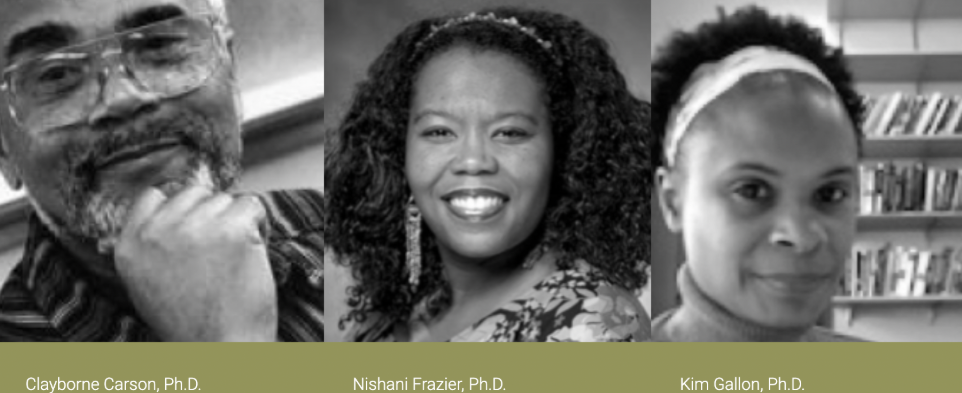
As our colleague Carolyn Miller aptly noted about kairos:
“The challenge is to invent, within a set of unfolding and unprecedented circumstances, an action (rhetorical or otherwise) that will be understood as uniquely meaningful within those circumstances. The timely action will be understood as adaptive, as appropriate, only in retrospect; …[it is] a philosophy of Becoming.”28
To conclude this first section, then, we pause to reflect on the way in which this publication itself is a tenuous thing. The technologies that the vMLK Project utilizes are themselves not stable. They continue to change and shift, with each new platform or software update. And a digital publication has a shorter life than a print book by several decades. Yet experiencing the vMLK Project – whether through a public community exhibition, a class unit, or reading this digital publication – can be a long lasting and powerful experience in becoming. An experience of becoming more knowledgeable about opportune moments and kairos, more immersed in key moments from history, more prepared to engage in civic participation, more aware of the rhetorical functions of sound, more aware of digital technologies and their world building capacities, and more knowledgeable about how to engage in ethical advocacy and reflection in and with communities. We invite you to continue this journey of becoming in each of the following sections.
