Cultivating Collaboration
The Listening Experience
Just you wait and see, I’m going to get me some big words.— Martin Luther King Jr.
Author Reflection: V. Gallagher
In his 2023 biography of Martin Luther King, Jr., King a Life, author Jonathan Eig recounts that a six-year old King told his family, “Just you wait and see, I’m going to get me some big words.”1 As Eig illustrates, King grew up surrounded by the big words of preaching and theology and, similar to Frederick Douglass before him, had a passion for words, for reading, for writing and for speaking. As Eig writes about King in his early years,
“He memorized long passages from the Bible. He learned hymns and, with his mother on piano, sang for church groups and conventions. He adored attention, competing not only with his siblings but also with his father, who stood and preached every Sunday before rapturous audiences. When his parents were away from home, their father’s church secretary, Lillian Wakins, babysat the King children. One of their favorite games was ‘church,’ and M.L. [MLK] always did the preaching.”
Having also grown up in a pastor’s family in the city of Detroit, this description resonates with me, Victoria Gallagher, in several key ways. I too grew up surrounded by preaching, theological discussions, church music and liturgy. And I often played church with my siblings both at our home and, most especially, at my great aunts’ home, which had a small organ in an alcove off the front room and a stair landing three steps up from the front room floor. This landing made an ideal pulpit from which I preached “sermons” to my siblings, grandparents, and great aunts.
I relate these experiences from King’s life and from my own to emphasize something that is central to the vMLK Project and indeed to King’s 1960 “Creative Protest” speech. Specifically, while the project is named the Virtual Martin Luther King Project, thereby centering attention on Dr. King and his historic 1960 speech, it is simultaneously a project that reveals that preaching, advocacy and activism are never solely the activities or provenance of a single, heroic person, whether in a church pulpit, on an aunt’s staircase or in a public square. Rather, the project illustrates how preaching, advocacy and activism are always enacted in and with others, in and with communities.
As with preachers and theologians before him, King modeled his preaching, sometimes his very words, on those that came before him. He engaged in imitatio, the classical rhetorical practice of emulating, adapting, and reworking the discourses of earlier authors and speakers. Imitatio is not simply copying, but a creative process of engaging with and building upon established models to develop one’s own style and voice. It has been used in rhetorical education and the study of homiletics (the art of preaching) for centuries. And, it also sometimes occurs in situ in the homes of clergy members as children imitate their parents.
From the start, then, the development of the vMLK Project was guided by a curiosity as to how digital technologies could enable the recreation or imitatio of historical events of public address, and specifically as Wells notes, “events in which agents in the past invoke and enable us (perhaps unwittingly) to create openings that will become available only in the future.”2 In so doing, we explore “the complexity and materiality of rhetorical practice, especially as it is technologically mediated and politically inflected”3 and as it emerges from/within communities. Drawing from Wells, we argue that a kairotic rhetorical practice is not solely a result of the communicative actions of a single heroic rhetor, but rather it is within anyone’s capacity: anyone may awaken to the possibilities and engage in a creative protest in and with their community(ies). As Dr. Keon Pettiway, a significant contributor and co-PI on the project from 2014 through 2019, noted in an interview, the vMLK Project “highlights that there were everyday people in Durham, North Carolina, students, people involved in religious organizations, who made a very great impact on our society and its civic innovation[s].” Dr Pettiway went on to express his hope that what people would take from the vMLK Project “is that a creative protest can be staged by anyone; you don’t have to be a King to do so.”
Overview
This second section, Cultivating Collaboration, further details the collaborative and iterative nature of the vMLK Project in relation to kairos as understood through the work of Susan Wells and her reading of Walter Benjamin. Specifically, we take up Wells argument that
“Understanding kairos as situated in Benjamin’s fluid time and framing the work of kairos as awakening contribute to current discussions of the concept in three ways: supporting a broad concept of agency; opening kairotic action to a range of accessible, rather than heroic interventions; and locating kairos in a wide array of public and private situations. Moreover, such an understanding connects agency, action, and situation to a past and future that act directly in the present.”4
Through detailed accounts of the community conversations at the genesis of the project, of the recreation event, the development of the audio recordings, the listening experiences, the initial version of the project website and public exhibitions, and the inclusive citational practices, in this section we present an approach to digital humanities/public scholarly work that enacts community and equity to do remarkable things.
Doing Remarkable Things In and With Congregations and Communities
And indeed, the members of the White Rock Baptist Church and the larger Durham community provide a clear illustration of the way in which everyday people do remarkable things by showing regard for the past and a keen anticipation of a future. The White Rock Baptist Church congregation was organized in 1866, one year after slavery was abolished in the United States and the same year that the first civil rights bill was passed by the Congress of the United States. The founder of the church was Mrs. Margaret Faucette who gathered a group of friends to meet regularly to pray and sing together. The congregation celebrated its 150th anniversary on October 21, 2016 with a festival service and banquet. The celebration was attended by the living descendants of Mrs. Faucette, current members of the congregation, members of the vMLK Project team, and notable members of the Durham political and civil rights communities, including G.K. Butterfield and Floyd McKissick, Jr., the latter of whose father–Floyd McKissick, Sr.–assisted Rev. Moore in training the Greensboro students in 1960. Over the course of its long and remarkable history in Durham, the congregation worshiped in multiple locations but the first brick building was completed in 1896. This structure, albeit renovated several times, was the building in which Dr. King gave his speech on the night of February 16, 1960 and serves as the basis for the audio/visual depictions and acoustical background sounds of the sanctuary for the vMLK Project.
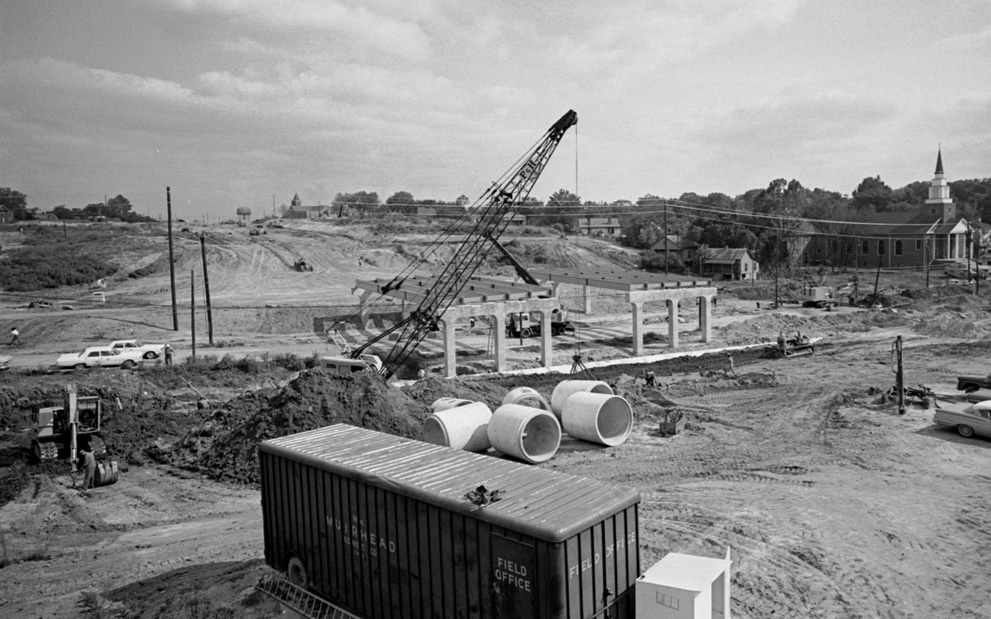
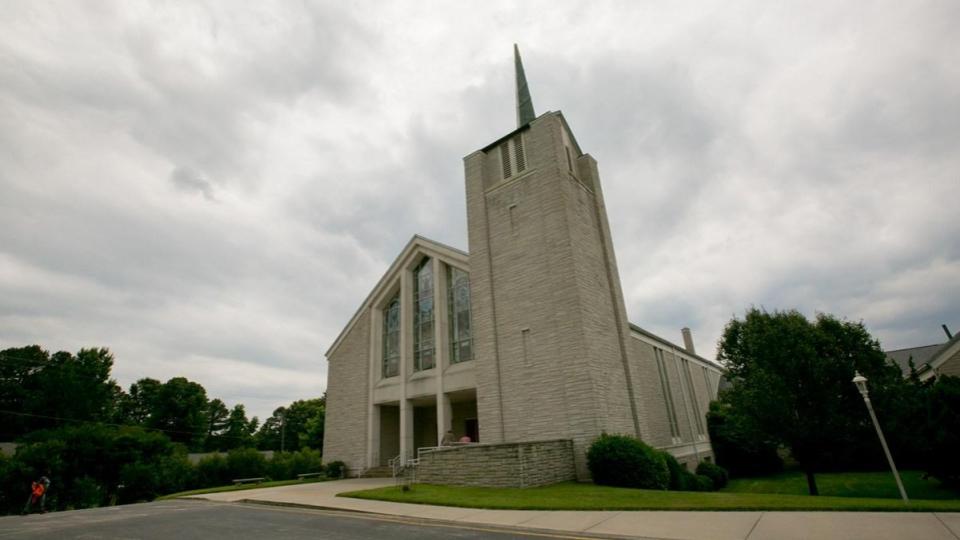
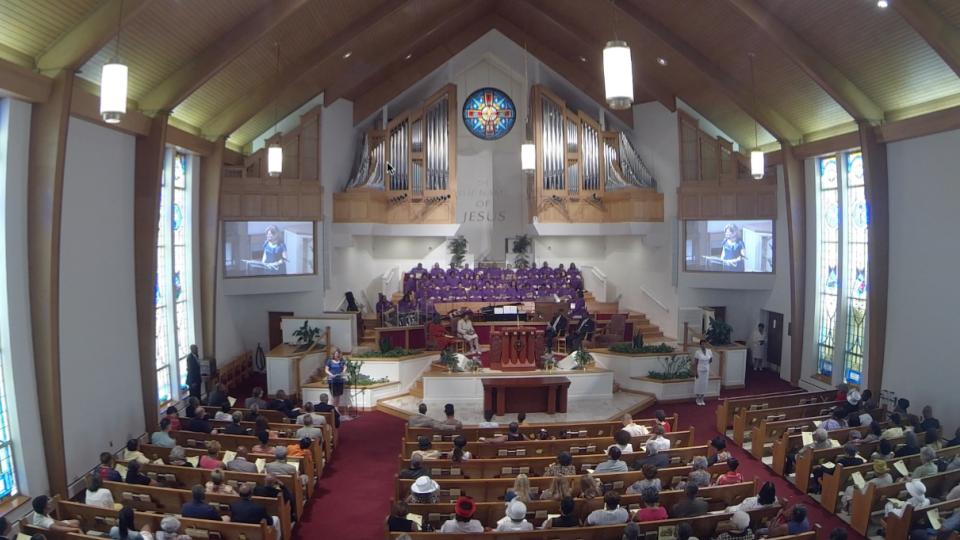
But, in the late 1960s, Durham city officials decided there was a need to connect the downtown city center with the growing suburbs and determined that they would build a freeway through parts of the historically black Hayti community in Durham. The White Rock Baptist Church sanctuary was in the middle of that community. It was slated for demolition and ultimately torn down in 1967. The congregation survived and built a new sanctuary at another location in Durham in 1971. That building was renovated and enlarged to the sanctuary where the June 8, 2014 vMLK re-creation of King’s speech took place.
Based on our early conversations with the White Rock Baptist Church community, as described in Section 1, we knew the project needed to be a recreation and recovery project, a creative process of engaging with and building upon the past. And, to be a collaborative project in the truest sense, vMLK needed to result in enhanced agency for all involved. Specifically, members of the White Rock community and of our team needed to be able to determine what goals should guide the partnership from the outset and also, iteratively, moving forward. In this way, we began by enacting in 2014 what scholars like Amy Earhart5 have identified as an essential characteristic of ethical approaches to developing successful communities of practice/partnerships (both within and beyond digital humanities work), namely, allowing each contributor to shape and reshape goals/development of projects.
During our conversations about what the project could look like and what it would need to be and do, members of the White Rock community expressed the importance to them/their community of having the recreation include a recovery of their historic sanctuary. We set out to accomplish this through sound recordings, archival images and digital modeling. In Sections 4 and 5, we examine in greater detail the development of the digital recreation of the sanctuary. Here, we focus on the creation/recreation of the sound recordings/mixes that are the basis of the vMLK Project.
As we further developed our collaboration and worked alongside members of the White Rock congregation and the larger Durham community, we came to see how the vMLK Project could productively materialize the oscillation between the significant impact of an individual speaker and the centrally important role of a community/audience in and through which transformation occurs, as well as the oscillation between past potential and future transformation. We could do this by recreating the moment in time when the speech was first enacted through a replication or imitation of the voices, the sounds and the acoustics of the space wherein it was enacted. And we could also feature the current/present church sanctuary and the current congregation in and through the reenactment. The results, as noted in an essay published in 2023, were truly remarkable:
Each component of the transmedia format of vMLK interacts with and complements one another to expand visitors’ knowledge of civil rights history in North Carolina. Visitors learn about and develop a deeper understanding of the transformative aspects of public address, particularly the call and response that characterizes African American and historically Black congregations and civic groups and the impact of that engagement on their own experiences of the speech. Visitors learn, in a manner and to an extent not previously available, how King’s speech text and his delivery served to move people to do something that was unthinkable for them up to this point in history, namely, breaking the law and going to jail to establish their humanity and to gain their rights and freedom. They are led to consider what this means in light of our contemporary political, civic, and social challenges and realities.6
Building Community through Sound
The four listening experiences were developed from audio recordings made on the day of the recreation event on June 8, 2014 and an “historic” sound mix that combined those recordings with studio recordings made the day after the live event. The historic sound mix also includes the acoustical characteristics of a vintage microphone, like the one King would have used in 1960, as well as recordings of ambient sounds from other historic sanctuaries of similar age and material composition/construction as the old White Rock Sanctuary. The sound recordings and the recreation event itself came about due to a set of circumstances that are significant to the project and to further conceptualizing opportune moments in and with communities. As described below, these circumstances set the context for interpreting and assessing the Listening Experiences of King’s speech and for the vMLK Project as a whole.
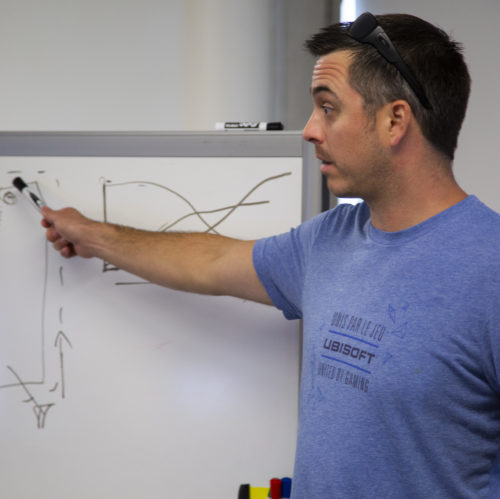
In June of 2013, a chance meeting on an airplane from London to Raleigh led to a fruitful collaboration that, in turn, informed key decisions regarding the sound recordings and sound mixes for the project as well as the development of the gaming and VR builds described in Sections 4 and 5. During that plane trip, the audio director for a North Carolina-based game studio, Justin Drust, described how he created soundscapes for digital games and expressed interest in working on a recreation/recovery project of historical importance as a way of showcasing the role of sound in immersive experiences.
Just a few months after this conversation, in the Fall of 2013, NC State University opened the Hunt Library to much acclaim. The newest library in the NC State Libraries system was described at its opening as “the academic library with the widest array of technologies in the country.” Indeed, it was the opening of this library and its technology spaces, including and most especially, the Teaching and Visualization Lab, that sparked the idea for the vMLK Project. For ours was not the first large-scale historical recreation model that Hunt Library housed. Our NC State colleague, Dr. John Wall developed a digital humanities project that premiered in the Teaching and Visualization Lab at Hunt Library in the fall of 2013. Dr. Wall’s “Virtual Paul’s Cross Project” features a digital recreation of John Donne’s Gunpowder Day Sermon, given in London in 1622. It is a remarkable project, rich in its efforts to exactingly recreate the experience of hearing public preaching after the Reformation in the Paul’s Cross church yard in 1622.
We attended the premier of the Paul’s Cross project in the Teaching and Visualization Lab at Hunt Library along with Mr. Justin Drust, the audio director at the game studio, and other members of the NC State and surrounding community. Interestingly, while acoustically accurate and fascinating, the sound experience of Paul’s Cross was less compelling than we had imagined, particularly in relation to its immersive and transformative qualities.
The Paul’s Cross project clearly succeeded in demonstrating significant attention to making an historically authoritative copy (acoustically and technologically). For instance, the sermon was originally written and performed in old English and so was the recreated version. The recreated acoustics of the church yard were also rendered – based on significant historical research and audio engineering expertise – to include all of the sounds/noise of the surrounding shops and homes. However, all of this attention to accuracy in the recreation made it somewhat difficult for a contemporary audience to understand and appreciate the content of the sermon unless they were already familiar with the text and its significance in literary/church history. Additionally, due to inclement weather, Donne’s Gunpowder Day Sermon was actually given inside the church sanctuary on that day in 1622, so the authentic nature of the acoustic recreation was at least somewhat undercut by the enactment of the sermon in the church yard rather than in the sanctuary.

These limitations of the 2013 version of the Virtual Paul’s Cross Project helped us to envision how our project might address or mitigate such issues: we could recreate a historically significant auditory experience inside of the White Rock church building, even if it was no longer in existence, by creating a sonic and digital model, allowing viewers/listeners to put themselves as closely as possible with the original community audience in 1960. And we could do it employing a rhetorical, rather than a literary or historically-informed perspective, since a rhetorically-informed perspective emphasizes and centers audiences and communities in relation to the speaker both in the past and in the contemporary moment.
This initial inspiration regarding what the space and technology could bring into being reflects a unique aspect of kairos, as ably articulated by Welsh, wherein communicators take up aspects of the past, including those that participants were not even aware of, and activate possibilities that were constructed but left dormant, in previous history.
Our original plan called for a Martin Luther King, Jr. voice actor to perform “A Creative Protest” speech in a Raleigh studio so that we could have “dry” mixes to manipulate. Once Mr. Drust, the game studio audio director, agreed to work on the project, we secured a speaker, Mr. Marvin Blanks (a well known King voice actor), and engaged in conversations with the White Rock church community. Everyone involved expressed enthusiastic support for the idea of a full recreation event at the church with a live audience, in addition to the studio sound recordings. So, on Sunday afternoon, June 8, 2014, Mr. Blanks enacted King’s speech (engaged in imitatio) for an audience of over 250 people. The event began with opening remarks by Pastor Reginald Van Stephens, continued with choral selections from the White Rock Church Choir, followed by introductions of special guests.
As part of the introductions that day, one of the church deacons, Mr. Jenkins, welcomed all in attendance and invited them to actively listen and participate with the speaker. This invitation resulted in a rich and diverse call and response experience for the live audience that quite accurately reflected the church and its traditions. It is important to note that the audience responses and participation that occurred on that day and that are captured in the audio recordings were not scripted. They emerged authentically from an enthusiastic and engaged live audience. The next day, Mr. Blanks performed the speech in an audio studio as well, giving us both the “dry” recordings and the “live” recordings to work with. These recordings became the audio building blocks for the immersive experiences developed in the next phases of the project.
The responses we received from people who attended the recreation event were remarkably positive and revealing. Members of the audience affirmed the extent to which Mr. Blanks captured Dr. King’s vocal character and they also affirmed the importance of being together, with others, in community to hear this historic speech. Several of the individuals who attended the recreation event had also been present at the original event in 1960. Virginia Williams, Raymond McAllister, Sr., and Mary Williams all remembered the excitement of the 1960 event, the inspiration and the transformation that occurred. But they did not remember much of the speech text itself. For them, being present at the recreation event sparked a renewed sense of the importance of the original message and its applicability to the contemporary context.
One person who attended the recreation event in 2014 was N.C. Rep. Henry M. “Mickey” Michaux Jr. of Durham. Dr. King often stayed with Michaux’s family and was even summoned to Washington by King to be with him for his “I Have a Dream” speech in 1963. Like Virginia Williams, Michaux was present at the “Fill up the Jails” speech in 1960 and, like her, he didn’t remember many of the words King spoke. In relation to Mr. Marvin Blanks, the voice actor who performed King’s speech for the 2014 recreation event, Michaux had this to say: “Having heard Martin, the intonations, well, he [Marvin Blanks] was making a good try at it,” he said. But once, maybe twice, every nuance fell into place and Michaux heard the voice of a friend he hadn’t heard in person for nearly half a century. He turned to his wife, June. “That was him,” Michaux whispered. “That was Martin.”
The recreation event thus connected agency, action, and situation to a past and future that acted directly in the present moment of 2014 on Mr. Michaux and on many others. For him and for the individuals who attended the recreation event, the past was not experienced as a fixed point but instead experienced as ‘the flash of awakening consciousness,’ as something happening in the present, opening new possibilities for kairotic action, new possibilities for doing remarkable things.
Rhetorical Listening
Hearing and listening are intricately related processes and, also, quite distinct. Hearing is the passive, physiological process of perceiving sound waves with your ears, requiring no conscious effort. Whereas listening is an active, voluntary, and cognitive process involving focused attention, comprehension, and interpretation of those sounds. Krista Ratcliffe’s work on rhetorical listening represents a nuanced conceptualization of listening that decenters authors/rhetors and actively foregrounds the embodied relationship and work of audiences.7 8 This emphasis on listening as a rhetorically vital act is important to the development of our conceptualization of kairos/opportune moments, to the field of rhetoric in general. It is certainly of contemporary interest for scholars, such as Elizabeth Miller in her book on the rhetoric of Civil Rights Mass Meetings.9 As we show below, rhetorical listening illustrates how audiences experience the project’s assets while also further illuminating the central role of sound in immersive experiences.
Ratcliffe offers the concept of rhetorical listening as a trope for interpretive invention. She argues that this kind of listening involves a conscious choice to assume an open stance in relation to any person, text, or culture. And, according to Ratcliffe, rhetorical listening “constructs a space wherein listeners may employ their agency…to foster conscious identifications that may, in turn, facilitate communication.”10 Ratcliffe goes on to explain that rhetorical listening conceptualized in this manner comprises the following moves:
- Promoting an understanding of self and others.
- Proceeding within an accountability logic
- Locating identifications across commonalities and differences
- Analyzing claims as well as the cultural logics within which these claims function
In unpacking these moves, Ratcliffe notes that
“…understanding means listening to discourse not for intent but with intent – with the intent to understand not just the claims but the rhetorical negotiations of understanding as well. To clarify this process of understanding, rhetorical listeners might best invert the term understanding and define it as standing under, that is, consciously standing under discourses that surround us and others while consciously acknowledging all our particular – and very fluid – standpoints. Standing under discourses means letting discourses wash over, through, and around us and then letting them lie there to inform our politics and ethics.”11
These ideas and conceptualization of rhetorical listening are particularly consistent with and useful for assessing the conceptualization, development and instantiations of the listening experiences for the vMLK Project. Rather than producing one listening experience from one location, we produced four distinctive listening experiences to account for the multiplicity of listening experiences on that night in 1960, on the afternoon of the recreation in 2014, and via the website and/or an in-person exhibition in 2015, 2020 or 2025. In theorizing public address as experience in and through the vMLK Project, we took up the notion of standing under and extended it to include standing with, within and alongside.
In our first exhibitions of the project, which utilized the project website and the sound recordings, we provided listening experiences that enabled audience members to hear King’s speech (enacted by the voice of Mr. Blanks) from four different locations: 1) the podium where King/Blanks spoke, with the choir sitting behind him, 2) from a position close to the speaker (front row), 3) from a position in the middle of the congregation and 4) from a position in the balcony. We then asked audiences to describe which listening experience was most compelling for them and why. Some audience members spoke about how the podium position listening experience made them feel that they were standing with King, feeling the power and intonation of his voice resonating in their own bodies. Others expressed how powerful it was to hear the sounds of the congregation members all around them, shouting affirming and encouraging words at key moments during the speech. Still others were intrigued by the experience of hearing the speech as if from the balcony, amplified by the sound system and resonating throughout the space. In this sense, these early exhibitions crafted the conditions for audiences to listen in the manner described by Ratcliffe: consciously standing under discourses that surrounded them auditoraly, while also consciously acknowledging and articulating particular – and very fluid – standpoints.
Fill Up the Jails Speech Reenactment – Perspective from the Podium
Fill Up the Jails Speech Reenactment – Perspective from the Floor
Fill Up the Jails Speech Reenactment – Perspective from the Balcony
Fill Up the Jails Speech Reenactment – Recorded on Historical microphone
These responses to the initial exhibitions of the project also provided insights for us as we prepared for the first public exhibition of the project, marking the 55th Anniversary of the Speech, at Hunt Library in 2015. This exhibition featured the following components: 1) an historic timeline projected on the walls of the Hunt Library’s Creativity Studio, 2) individual listening experiences with headsets in the Creativity Studio, 3) a collective sound experience of the speech in the Teaching and Visualization Lab, and 4) the “Your Creative Protest” feedback experience in the Creativity Studio.
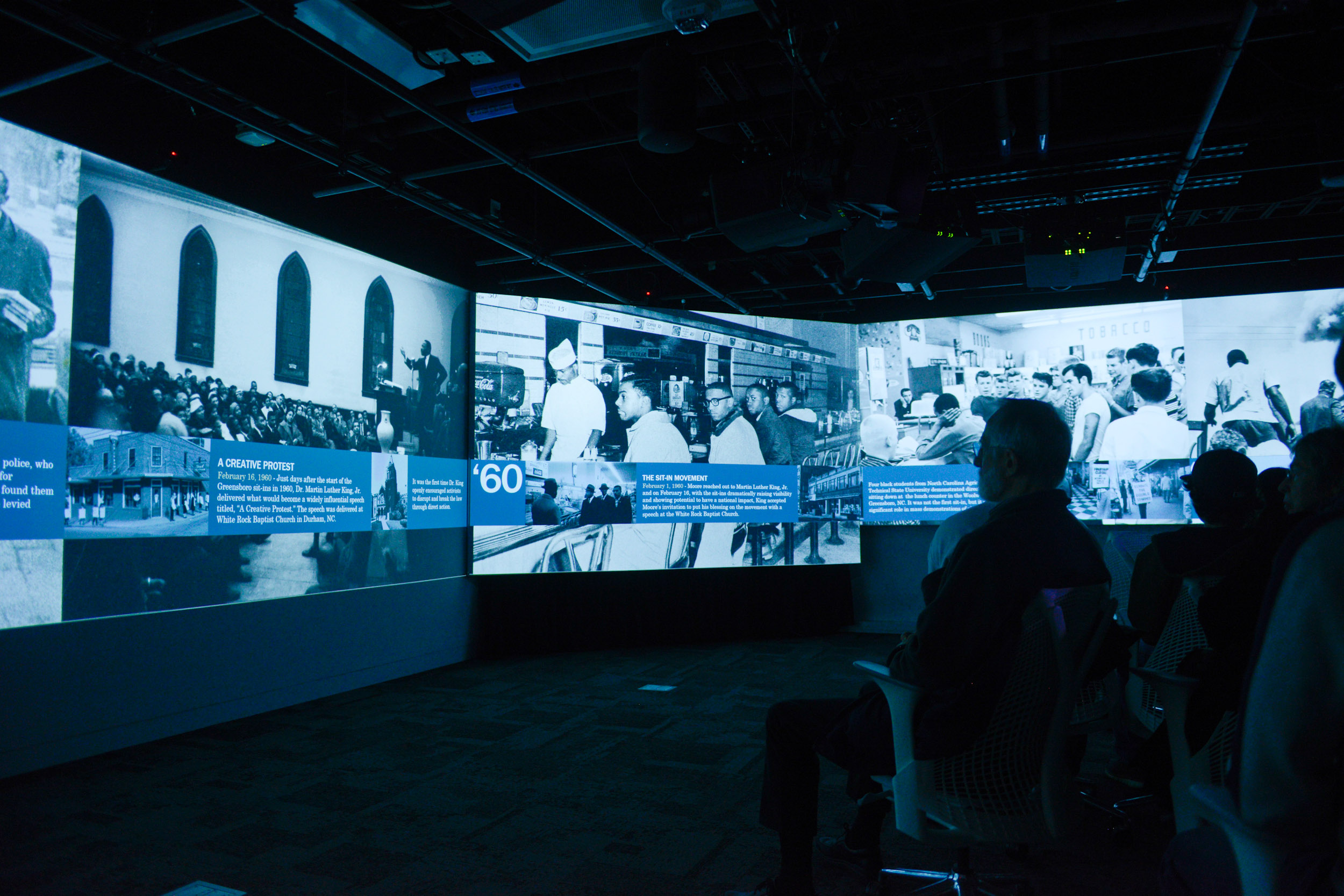
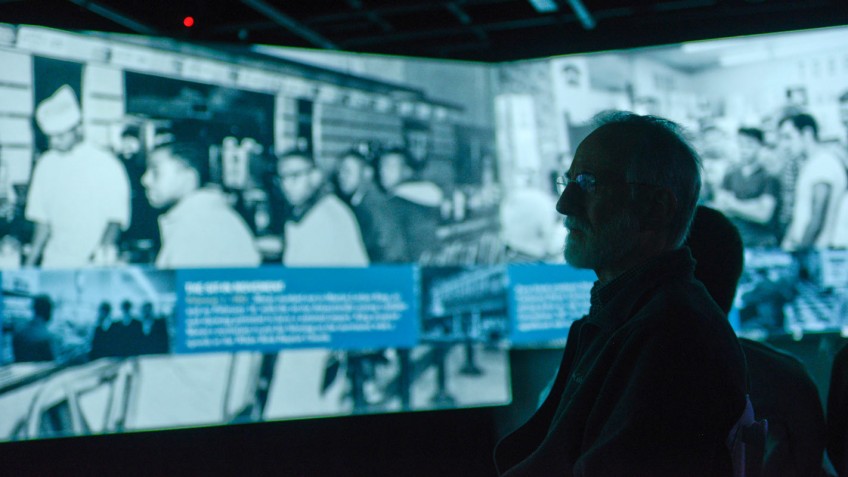
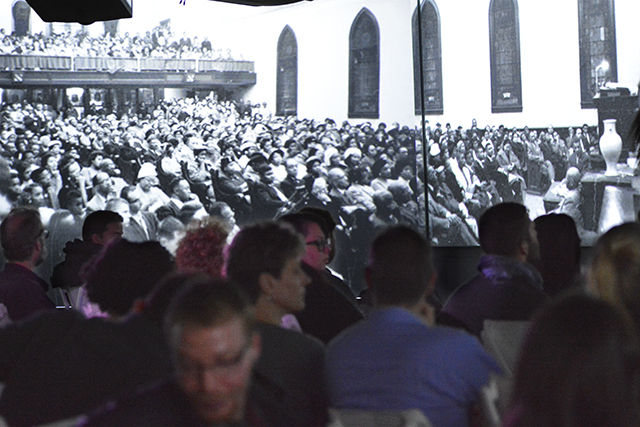
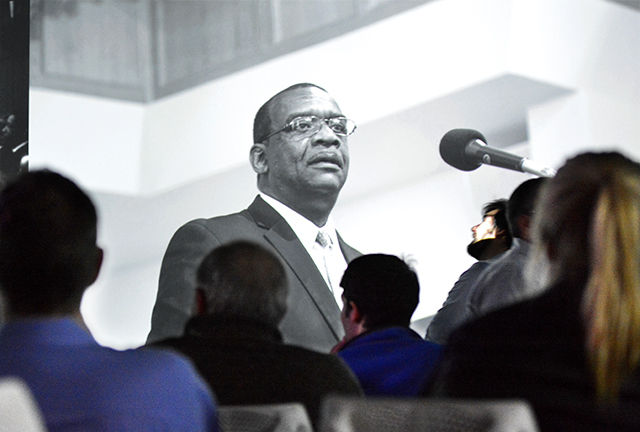
On the day of the 55th Anniversary exhibition, several men in the audience, who had been students at Duke Divinity School in 1960 and were now in their 70 and 80s, spoke with vMLK team members and other visitors about how moving it was to hear the speech in its entirety again. They showed us where they had been sitting that night in February 1960 in the historic sanctuary by orienting themselves in the Teaching and Visualization Lab, using the 280 degree visualization compiled from the historic photographs of the church that night. They pointed out their own faces among the faces of the people in the historic photographs that now surrounded them in the space. They were eager to share their stories and, also, to speak especially with younger visitors about what it had been like then and why it was important to listen to the speech still today. Ms. Virginia Williams, who also attended this event, shared that this was the first time she really heard the entire speech, even though she had also attended the recreation event in 2014. She reminisced about being in the balcony in 1960, noting that as a woman of petite stature in a crowded balcony, her listening experience was negatively impacted and yet, she recalled how the energy of the congregation and community surrounded her and compelled her to continue to advocate for the end to segregation. Each of these individuals spoke of the vMLK sound experience as meaningful, moving and remarkably important to developing understanding of self and others, particularly in the current moment and also in relation to this past moment.
Enacting Equity
Another key aspect of Ratcliffe’s conceptualization of rhetorical listening that is significant for assessing the vMLK Project and the listening experiences has to do with ethics and decision making. As Ratcliffe notes:
“Linking the ethical to understanding is a necessary element of rhetorical listening. Granted, we may not always choose or control the discourses that socialize us; neither may we choose or control our unconscious responses to these discourses. But we can to a limited degree, articulate our conscious identifications and choose to respond to them (or not); in this way we become responsible for our words, our attitudes, and our actions.”12
Ratcliffe goes on to quote Diane Davis: “What is needed now is an ethics of decision; to the extent that we may no longer simply be guided by ontological Truth, by light or by logos, decisions have to be made. And any ethics of decision necessitates first a ‘hearing’ – double entendre intended: it necessitates both a listening and a judging.”13
Based on the responses of audiences to the listening experiences in these early exhibitions, it became clear that the vMLK Project provided an approach to listening and understanding that featured enactments tied to ethics and commitments. The sound experiences provided visitors an embodied connection to history, one that they expressed as also relevant to their lives today, wherein listening and feeling were identified as key aspects of the experience. Additionally, the listening experiences reminded audiences that history is made of people, not just their ideas. As Ratcliffe notes,
…rhetorical listening turns hearing (a reception process) into invention (a production process), thus complicating the reception/production opposition and inviting rhetorical listening into the time-honored tradition of rhetorical invention.”14
A significant question that emerged from these initial exhibitions for the project, had to do with how and to what extent the project itself could enact or model justice work through furthering the move from reception to production/rhetorical invention for audience members. Here, justice work is conceptualized as work(s) that connect(s) people to legacies of social movements in ways that build community and capacity for all of those involved. In other words, how could we continue the legacy of the White Rock Baptist Church, of Dr. King, and of all of the everyday people who did remarkable things in 1960?
In addressing this question, we developed the following articulations and then enacted them in two key ways. First, we began to think about how the vMLK Project and its assets could be utilized in teaching, particularly in public speaking courses and other communication classrooms. Working with the Director of Public Speaking at NC State, Dr. Elizabeth Jones, we conceptualized how teaching with vMLK could enable students and faculty to:
- Engage deeply with an under explored historical moment
- Connect people to legacies of justice work and social movements
- Offer multiple modes of experiencing history (e.g., embodied, aural, communally, accessibly)
- Discuss what it is to recover history in/alongside community
- Model relationships and accountability with multiple stakeholders
- Reveal how the world is transformed by “everyday” people like us/them
- Encourage participation in civic life as a way to “do something”
As we describe further in Section 3, these ideas became the foundation for the development of the Collective Sound experiences of the project and of the curricular materials and partnerships we developed with other Colleges and Universities.
Second, we reflected on the research aspects of the project to consider the insights this project offers in relation to how to create conditions for equity in academic and community life. We developed the following set of ideas to encapsulate this.
Research can be justice work in relation to the extent that:
- The time, energy, resources devoted demonstrate a sustained commitment to both the research and to community engagement.
- A wide variety of research is supported in the ongoing/continuous growth of the project.
- Multiple possibilities for participation in the research and creation process are supported through/throughout the project.
- Multiple possibilities for engagement(s) with the project over time allows people to experience research outputs after the moment of the first encounter.
- The work reminds us that significant actions, events, etc. happen around us all the time and provide us with resources for recognizing, reflecting on and participating in them.
As noted in Section 1, throughout this digital publication, we attend to how decisions are made, who makes them, whose bodies and voices are seen and heard and in what ways. One of the ways we do this is through a robust and inclusive citational practice of acknowledging people and their contributions to the project. As our “Contributors” page demonstrates, the iterative nature of this project is illuminated by making visible the people who contributed and the various ways they did so, throughout the history of the project. The community that brought the vMLK Project into being and continues to nurture and celebrate it further illustrates how a kairotic practice can lead to remarkable outcomes when enacted in and with communities.
In this section, we introduced several key concepts that are significant to the rest of the publication: public address as experience – an embodied conceptualization of public speaking and rhetorical listening – and ethical advocacy conceptualized here as work that brings to the fore the relationship between communities, opportune moments, decision making and ethics. Both of these concepts are further developed in Section 3.
The development of the listening experiences as detailed throughout this section illuminates how we addressed the White Rock Baptist community’s desire to have the project recreate their historical sanctuary, albeit through sound. And as illustrated through audience members’ responses, how and to what extent these sound/audio experiences serve to transport people into that evening in 1960 when Dr. King’s “big words” inspired everyday people to join together to do remarkable things.
